This article provides all relevant information about wage types in payroll accounting and how to set them up and manage them in Personio Payroll.
General
What are types of wages?
Wage types serve as standardized classification systems in payroll accounting, according to which all payments and benefits to employees are recorded, assigned and evaluated uniformly.
Each payment within the payroll accounting process is assigned to a clearly defined wage type, which is defined by accounting-relevant characteristics. This determines how a payment is calculated, which accounting rules apply, and which taxes are payable to third parties.
Types of wage types
Gross wage types
Gross wage types include all wage types that are recorded in the payroll accounting as payments or gross-reducing deductions and, depending on their designation, serve as the basis for calculating taxes and social security contributions. The decisive factor is whether a type of wage is subject to tax and social security contributions, tax-free, exempt from social security contributions, or partially exempt.
| Gross income |
Gross earnings include all benefits that increase the salary. These amounts are generally added together and, if they are subject to tax and social security contributions, form the basis for calculating tax and social security contributions. These include:
Danger: There are also gross salaries that are tax-free and/or exempt from social security contributions. Although these amounts are shown as gross income, they do not increase the assessment basis for tax and/or social security contributions. |
| Gross deductions |
Gross deductions are wage types that are deducted from the gross salary and reduce the total gross amount. If a gross deduction is treated as subject to tax and social security contributions, it can reduce the assessment base and thereby lower taxes and social security contributions.
These include:
|
Tax-free gross wage types
Not all types of wages have an impact on income tax and social security. According to Sections 3 and 3b of the German Income Tax Act (EStG), the legislator provides for numerous full or partial tax exemptions. If employees and employers meet the requirements, these can be taken into account in the payroll accounting. Many tax exemptions only apply up to a certain amount. If this limit is exceeded, additional taxes may be due.
Tax-free wage types must be shown with the appropriate identifier in the payroll accounting.
Examples of tax-free wage types include:
- Surcharges for Sunday, public holiday and night work
- Child care allowance
- Benefits in kind and tokens of appreciation
- Reimbursement of expenses
- Contributions to the company
Tip:
If you wish to implement these types of wages for your company, it is important to first familiarize yourself with the legal requirements. Many of these types of wages are subject to certain allowances and limits. If the amount is exceeded, it may result in full or partial taxation.
Net wage types
Net wage types are wage types that are only taken into account after the deduction of taxes and social security contributions. Therefore, it does not change the taxable and social security-liable assessment basis, but only the actual payment amount. The employer's payroll taxes also remain unaffected.
| Net price |
Net income includes payments that are not subject to income tax or social security contributions. These are often refunds that are paid out directly. These include, among others:
|
| Net deduction |
A net deduction is an amount that is taken from the net wage without changing the tax and social security calculation. These are usually deductions or amounts that are passed on to third parties. These include, among others:
|
Statistical wage types
Statistical wage types are used exclusively for evaluation and reporting purposes. They do not affect the calculation of taxes or social security contributions, but are used for reporting to tax offices, social security institutions and statistical offices.
Note
Personio Payroll does not currently use statistical wage types in payroll accounting.
Structure of wage types
Wage types on the pay slip
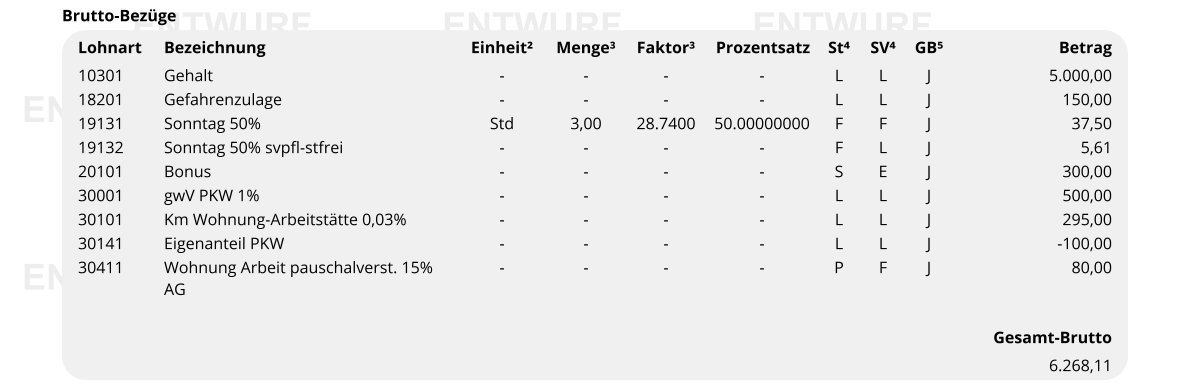
Wage types are structured as follows on the Personio Payroll Payslip:
| Field | Description |
| Salary type | Unique five-digit code for identifying the wage type in payroll accounting for evaluation and allocation. |
| Name | Description of the wage type on the pay slip |
| Unit | Unit that refers to the wage type, such as hours. |
| Crowd | Number of units to be billed (e.g. 10.00 hrs.) |
| Factor | Multiplier for the calculation (e.g., the hourly wage) |
| percentage | Percentage used for the calculation (e.g., for shift allowances) |
| St. | The type of tax treatment of the wage type. |
| Sv. | The type of social security treatment of the wage type. |
| GB |
Assignment of whether the wage type is included in the total gross pay. Important: The total gross amount is not automatically identical to taxable gross or social security gross amount. |
| Amount | The final amount calculated for the wage type. |
Salary Type ID
In Personio, each wage type is represented by a five-digit number. This number provides information about how the wage type is categorized. The category can be determined from the first digit of the wage type number:
| First digit of the wage type number | Category | Note and examples |
| 1 | Current payments |
|
| 2 | One-off and other payments |
|
| 3 | Benefits in kind |
|
| 4 | Company pension schemes and employee savings plans | |
| 5 | Net income and deductions |
|
| 6 | special billing issues |
|
| 7 | Social insurance | This is purely a system wage type, which is not printed on the pay slip. |
| 8 | Tax | This is purely a system wage type, which is not printed on the pay slip. |
| 9 | Transfers | Carryovers of payments from previous months |
Note
The wage type numbers and descriptions may vary depending on the system provider. There are no binding requirements regarding what these must look like and how many positions they should comprise.
Abbreviations for wage types on the pay slip
The pay slip contains various abbreviations for both the tax and social security management of wage types. These specify how taxation and social security contributions are individually structured for each type of wage:
| abbreviation | Name | Description |
| L | Recurring payments | regularly recurring remuneration (e.g. monthly salary or monthly allowances) |
| S | Other reference | Irregular payments that are not part of regular wages (e.g. (Bonus, premiums); relevant for tax calculation |
| F | free | Tax/social security exemption, either fully or within the limits of permissible allowances (e.g. shift allowances) |
| E | One-time payment | One-off payments (e.g., bonuses, premiums); relevant for social security calculations |
| P | Flat rate | Tax is levied as a lump sum (e.g., on certain non-cash benefits). |
| M | multi-year taxation | Tax treatment based on a multi-year logic (e.g., severance pay) |
| N | Tax calculation for the following year | Tax treatment will only take place in the following year. |
| V | previous year | Retroactive payment, in which the payment is allocated to the previous year |
| W | remuneration credit | Reference in connection with a value credit/salary credit (e.g. time value account), with special tax/social security classification. |
| YES | Annual balance | Label for matters that are taken into account/balanced within the framework of an annual reconciliation. |
Manage wage types in Personio
Setting up wage types in Personio Payroll
Further information on setting up wage types can be found in the following Help Center articles:
- Wage types for one-off payments
- Wage types for recurring payments
Contact Payroll Support
If you have entered the wage type in Personio, please contact our Payroll Specialists as the person responsible for payroll. Please include the following information regarding the wage type classification in your ticket:
- Whether it is a gross or net payment
- how the taxation should be handled (free, ongoing, one-off or lump sum)
- how social security contributions are structured (free, ongoing or one-off) and
- whether an automatic net deduction will be made
- whether the wage type is subject to garnishment
- for example, whether it may be reduced in the case of unpaid absences.
- whether other special characteristics are present (e.g. whether the wage type is included in short-time work compensation)
Note
If taxation is to be carried out on a flat-rate basis, please also specify the tax rate at which it should be applied and whether the employer or employee bears the flat-rate tax.
Accounting for wage types
In order for wage types to be displayed correctly in the accounting report and recorded in the accounting system, they must be assigned accordingly in the Personio settings.
You can find more information in our article on the topic .