This article explains what the electronic certificate of incapacity for work (eAU) is, what legal obligations it entails, and how to manage the EAU process in Personio Payroll.
What is the electronic certificate of incapacity for work (eAU)?
The medical certificate of incapacity for work (AU) is generally the only legal proof of an employee's inability to work due to illness. The attending physician issues this and states the start and expected duration as well as a note as to whether it is an initial or subsequent certificate.
Since January 1, 2023, medical practices have been transmitting the sick report digitally via the Electronic Certificate of Incapacity for Work (DTA eAU) procedure directly to the statutory health insurance company. This then makes the data available to the employer for retrieval. Since January 1, 2025, the procedure has also covered the retrieval of rehabilitation and care services.
Personio Payroll automatically retrieves eAU from the responsible health insurance company as soon as there is an inability to work due to illness and all relevant requirements have been met.
Requirement to notify and provide evidence
In accordance with Section 5 (1) sentence 1 EFZG, the employee is obliged to immediately report the inability to work and its expected duration to the employer. The form of the notification is irrelevant. It can be done orally, by telephone, via WhatsApp or email.
If the incapacity to work due to illness lasts longer than three days, the employee is obliged in accordance with Section 5 (1) sentence 2 EFZG to provide medical certificate of existence and expected duration no later than the fourth day. At its own discretion, the employer may also request the template earlier. If the incapacity to work persists beyond the certified time period, the employee must provide new certificate.
If the employee does not provide proof, the employer may refuse payment of remuneration in accordance with Section 7 (1) EFZG until template certificate has been presented. An exception applies if the employee is demonstrably not responsible for the delay.
With eAU, the obligation to provide evidence for employees with statutory health insurance is largely eliminated, as the employer retrieves the certificate independently.
Employer Responsibility
The employer retrieves eAU via a system-tested payroll program or, alternatively, via the SV reporting portal. It is responsible for ensuring that EAU data is processed and stored correctly. He also ensures that data processing is carried out in accordance with data protection regulations.
Scope
In principle, the procedure applies to all employees with statutory health insurance, regardless of whether membership exists directly or, for example, through family insurance. Minor employees in accordance with Section 8 SGB IV are also included, provided that they are members of a statutory health insurance scheme.
Exemptions from the EEA regime
There is no retrieval option for the eAU in the following cases. In these cases, the employee is required to submit a paper certificate of incapacity for work:
- Minor employment in private households
- employees with private health insurance
- private medical treatment
- Treatment abroad
- Illness of the child
- work prohibition during pregnancy within the meaning of the Maternity Protection Act
- gradual reintegration
The electronic submission process
In order to guarantee that the eAU is transmitted directly to the employer by health insurance, the attending physician must first send the necessary information to the employee's responsible health insurance company.
Accordingly, the doctors and institutions participating in the EAU procedure are required in accordance with Section 295 (1) sentence 1 SGB V to transfer all necessary data relating to the inability to work to the respective statutory health insurance company using a secure transmission procedure.
However, transmission of the data does not preclude the attending physician from their obligation, pursuant to Section 109 (1) Sentence 5 SGB IV, to issue a certificate to the employee, who is also the insured person, to confirm their incapacity for work.
After receiving the necessary data on the incapacity for work, the health insurance company must then submit a retrieval contribution statement for the employer.
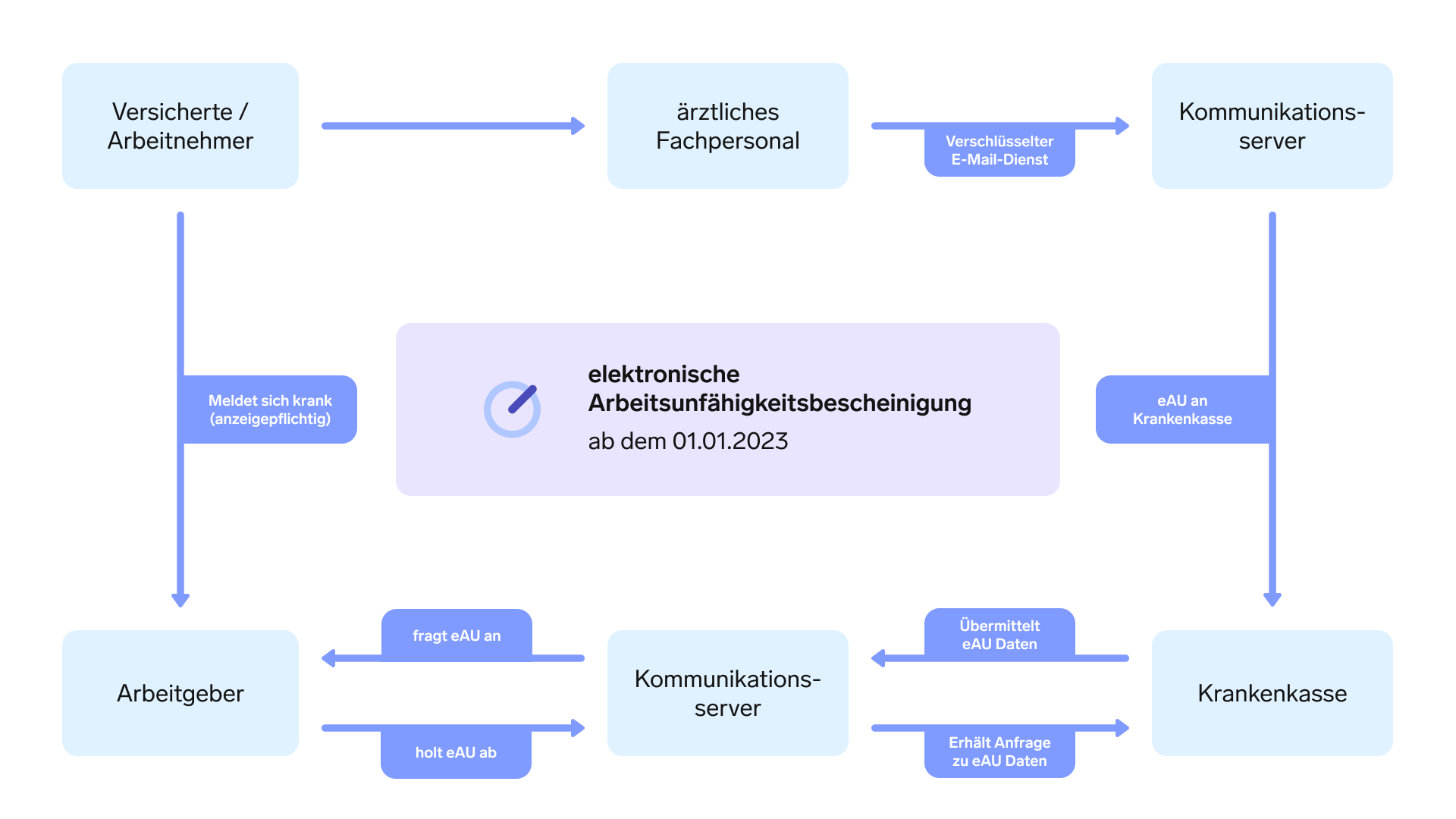
Contents of the eAU
What does the eAU include?
The eAU, which the employer can obtain from health insurance, contains the following content:
- Name of employee
- Start and end of the incapacity for work
- Date of medical assessment
- Information about whether it is a first or a follow-up certificate
- Information about whether the incapacity is due to a workplace accident or another accident or consequences thereof
If it is an inpatient stay in hospital, the date of admission and the expected duration will also be announced.
Reporting reasons eAU
| Reason for reporting | Description |
| 1 | incompetent health insurance/ unknown person |
| 2 | Incapacity for work (AU) |
| 3 | hospital |
| 4 | certificate is not available |
| 5 | Rehabilitation/preventive services |
| 6 | semi-inpatient hospital treatment |
| 7 | under review (interim notification if incorrect information is clarified) |
| 8 | other certificate is available (foreign or private medical AU) |
| 9 | Referral procedure in accordance with Section 34 SGB V (forwarding when changing health insurance) |
manage eAU with Personio Payroll
Before you begin
First, make sure that the following requirements are met:
- The affected employee has statutory health insurance. Employees in private health insurance must continue to manually upload their certificate directly in their absence. This can be done via the absence tab in the employee profile or the team calendar.
- The absence is configured as the illness absence type and is approved for EAU retrieval
- You have editing rights for the corresponding absence.
Status of eAU retrieval
The status of the EAU call can be viewed during absence in the employee profile or under Payroll > Reporting.
Status of eAU in absence in the employee profile
| eAU pending | The eAU was requested from health insurance. Personio has not yet received any feedback. |
| eAU received |
The health insurance companies have reported the disability data available to them back to the employer. Please note: |
| eAU not found | The insurer does not have any data on incapacity for work for this employee. |
Compliance
Different cases can appear in the Reporting system tab of Personio Payroll:
The EAU query has not yet been sent. |
The system has not yet sent an EAU query to health insurance. This is done within a period of 4 days. As an employer, there is no need for further action for you as an employer for the time being. |
The eAU data matches |
The eAU has been confirmed by the insurer and the details match. In this case, no further verification is necessary. Check whether the eAU is stored in absentia. |
There is no eAU that matches this period. |
The health insurance company reports back that it does not have an eAU that fits the requested time period. Contact the employee and verify that the entered periods of the incapacity for work are correct. Alternatively, the employee can continue to provide the employer with his certificate of incapacity for work in paper form. |
Wrong health insurer |
The health insurer reports back that the employee is not insured with them. After consultation with the employee, check the accuracy of the profile and correct it if necessary. |
Automatic retrieval of eAU
Personio Payroll automatically triggers the eAU to be retrieved as soon as there is an absence in the illness category and the period of absence and all necessary requirements have been met. Subsequent sick reports, which are linked to an existing absence via an import, also automatically trigger an EAU call. If the absence starts before the date that the Organisation became an active Personio Payroll customer, no EAU call is made.
Employers have the option of retrieving EAU data retroactively for the period of employment from 01.10.2021 and within a limitation period of four years.
Individual absence period
To retrieve the electronic incapacity for work, proceed as follows:
- Open the corresponding employee profile and switch to the Absence tab.
- Click on Request an absence and enter the type of absence associated with illness and enter the date.
- When you're done, click Send Request.
Personio Payroll then automatically checks whether the requirements for a call have been met and requests the eAU from health insurance:
- The attitude to the obligation to provide evidence set out in the time-off policy, including from which date a certificate is required.
- The employee has statutory health insurance.
- The absence is configured with the absence category of illness and approved for EAU retrieval.
Extended absence period
Personio automatically makes a follow-up request if an eAU does not cover the entire absence period. This applies to the following scenarios:
- Continuous, consecutive absences: If several absence periods follow one another seamlessly, Personio automatically recognizes this and starts retrieving the deadline set in accordance with the absence guidelines, even if individual periods are shorter. After receipt of the first eAU, a follow-up request is automatically triggered for the following time period.
- Extension of an already confirmed absence period: If there is an eAU that has already been confirmed for an absence period and is subsequently extended, Personio automatically makes a follow-up request for the additional days.
- Partial coverage by health insurance: If the returned eAU only covers a shorter period of time than the actual absence, a follow-up request is automatically made for the remaining period.
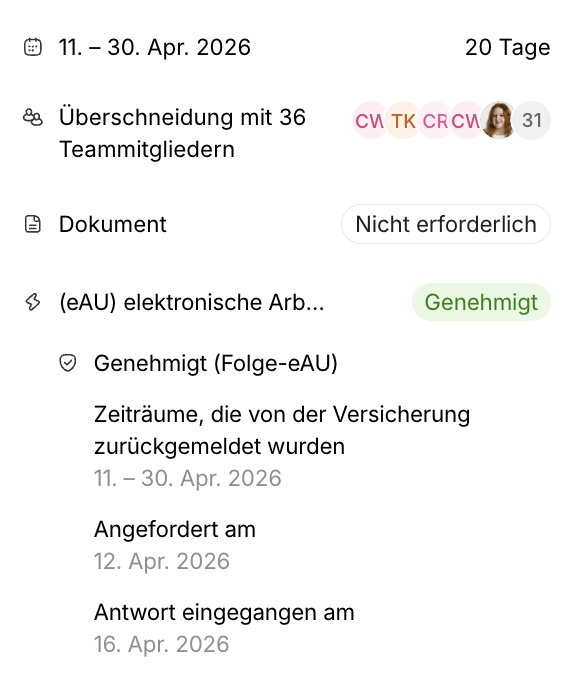
If you want to extend an employee's illness period, proceed as follows:
- Open the corresponding employee profile and switch to the Absence tab.
- Select the absence that you want to edit.
- Click on the pencil icon to edit the absence.
- Enter the new end date and click Save.
EAU retrieval for imports
If the absence is created via an import, Personio Payroll automatically checks the requirements and makes the EAU request if necessary. This also applies to subsequent absences which, as part of the import, are linked to an existing disability due to illness.
You can find out more theme importing absence timeline in our article on the topic.
Eliminate electronic incapacity for work
Delete an absence after you have sent an EAU request to the health insurance company, only in the following cases:
- Wrong information: If the absence or employee data contains errors and you need to correct the information sent to health insurance.
- Response pending: If you have not yet received an answer from the health insurance company.
Once you have received a definite answer from the insurer (whether the eAU is covered or hasn't been found), you can only delete the absence if the information provided was incorrect.
Please make sure that all information is correct before submission in order to prevent unnecessary deletions.
EAU notifications
Personio automatically sends notifications via email and in the Personio account about EAU retrieval status updates. Who is notified depends on the approval status of the associated absence:
- If the absence has not yet been fully approved, the person is informed of the current approval step.
- If the absence has already been fully approved or the approval has been skipped, only the person of the last approval step is informed.
- If the absence was created without a stored approval rule, the person who created the absence is notified (unless it concerns the person himself).
If there is an error during retrieval or if there is no eAU, this will also be reported. Each time the EAU request is updated, the affected employees are notified again.
FAQ
Do I have to manually trigger the EAU retrieval?
No. The retrieval is automatic; manual selection is not possible.
Does an imported absence period also trigger an EAU retrieval?
Yes, a retrieval including linked subsequent absences is also carried out for an imported absence period.
Can an absence period be approved before the eAU has been received?
Yes, the retrieval and approval process run independently of each other. The eAU is automatically requested in the background, while the approval process can be carried out as usual.
Is an eAU also automatically retrieved for “child ill” (child sickness leave)?
No. Automatic EAU retrieval is only possible for absence types with the “Illness” category. For children's sick days, a paper certificate must still be uploaded manually.
Does this function also apply to employees with private health insurance?
No. The eAU and automatic retrieval are only available to employees with statutory insurance. Privately insured employees must continue to manually upload their certificate to the employee profile in the corresponding absence.
What happens if the absence period is changed retrospectively?
If an absence period is changed (e.g. extended) after the initial EAU request, Personio Payroll automatically triggers a new EAU query for the changed data. You don't have to do anything manually.
Why do I see multiple EAU entries for an employee?
If there are continuous or extended periods of time, it may happen that several EAU certificates are available for an employee. Since each certificate covers a portion of the total period, this is expected behavior.
How many follow-up requests does Personio make?
Personio makes as many follow-up EAU requests as necessary to cover the entire absence period. Several follow-up inquiries arise in particular when the health insurance company returns a valid eAU that only partially covers the time period. In this case, a new request is automatically made from the end of the last reported eAU. This is done as long as the time period is completely covered.
If a negative contribution statement or error message comes back, it may be necessary to restart the query, for example by creating a new absence period.
Do I have to divide the absence period if there is an initial certificate and a subsequent certificate?
No. It is not necessary to divide the absence period into separate periods. Several EAUs can be assigned to an absence period. Personio Payroll automatically requests follow-up EAUS if the period is not fully covered.
What happens if a follow-up EAU request fails?
If a subsequent EAU request is not successful, the status “Not available” remains. All requests are logged so that, together with Support, you can understand when and why a request was unsuccessful. In this case, contact Personio Support.