This article explains the tax and social security law basics of company car leasing. It also shows how to store and manage a company car agreement in Personio Payroll.
What is a company car?
A company car, also known as a company car or company car, is a company motor vehicle that the employer makes available to an employee. If the employee is also allowed to use the vehicle privately, there is a monetary benefit. This advantage is remuneration subject to tax and contributions.
The permitted private use and not the actual use is decisive. The non-cash benefit is deemed to have accrued as soon as the vehicle is made available.
| Type of company car | Description |
| without private use | There is a ban on use and the vehicle is used exclusively for business purposes. There is no benefit in kind. |
| with private use | The vehicle may be used privately. The benefit of use is remuneration and must be taken into account in the payslip. |
Note
A ban on use must be proven by documents in the employment contract or service law.
Methods for assessing non-cash benefit
You can determine the non-cash benefit for private use in two methods:
- 1% rule: flat-rate calculation on the basis of the gross list price.
- Logbook method: custom calculation based on the actual kilometres driven and the vehicle costs.
The 1% rule applies if the employer and employee do not expressly opt for the logbook method. The decision is valid for a whole calendar year. Exceptions are, for example, a change of vehicle in the current year or a retroactive change for the entire year. If an employee has several company cars at his disposal, the method can be selected separately for each vehicle.
This article deals with the 1% rule. Details about the logbook method and the application in Personio Payroll can be found in ourRelated articles.
The 1% rule
In the case of the 1% rule, 1% of the gross list price is applied each month for private use. It does not role how often the employee actually uses the company car privately. The 1% rate covers all costs that directly serve to maintain and operate the vehicle. These include depreciation or leasing instalments, operating materials, maintenance and repairs, vehicle tax, insurance and financing interest.
It does not cover costs that only indirectly arise from the use of the vehicle. These include, for example, tolls and parking fees, vignettes, garage costs, an ADAC cover letter and fines. If the employer reimburses such costs, there is additional taxable wages. Exceptions exist for business trips.
Gross list price as a basis of assessment
The manufacturer's domestic recommended price at the time of initial registration is decisive. It includes VAT and factory optional equipment. They round off the amount to a full €100. What counts is the price at which a private customer could purchase the vehicle as a new car.
These principles apply to the gross list price:
- It also applies to used and leasing vehicles.
- The actual purchase price or a dealer discount is irrelevant.
- If there is no domestic list price for an imported vehicle, a comparable price is estimated.
- For a first registration from 01.07.2020 to 31.12.2020, the price shown at that time remains decisive with 16% VAT.
Factory optional equipment only increases the gross list price if it was already installed at the time of first registration. Retrofitted equipment such as a parking heater or a liquefied gas system does not increase the gross list price.
| Equipment or costs | Increases the gross list price |
| Trailer hitch | yes |
| Car radio | yes |
| Anti-theft device | yes |
| Driving and safety assistants | yes |
| Air conditioning | yes |
| Navigation system | yes |
| Auxiliary heating | yes |
| Car phone | no |
| Roof racks | no |
| Hands-free kit | no |
| Additional set of tyres with rims | no |
| Transportation costs and dealer fees | no |
| Vehicle registration fees | no |
Calculation of the non-cash benefit
The calculation of the non-cash benefit consists of two components:
| Component | calculation | Purpose |
| Private use | 1 % x gross list price | Advantage for private trips |
| Journeys between home and first place of work (monthly flat rate) | 0.03 % x gross list price x distance kilometers | Surcharge if the employee is allowed to use the vehicle for commuting to work |
| Journeys between home and first place of work (daily flat rate) | 0.002 % x gross list price x distance km x number of trips | Surcharge if the employee is allowed to use the vehicle for commuting. The daily flat rate is mapped in Personio Payroll at the current time with manual wage types. Further information can be found in our Related articles. |
Both amounts are assessed for the full calendar month. This also applies if the employee only receives it in the course of the month or does not use it due to vacation or illness. A pro-rata reduction in time is not permitted.
Employee's own contribution
If the employee contributes to the cost of the vehicle, this reduces the non-cash benefit. The co-payment can be as follows:
- Usage fee: fixed monthly flat rate, mileage allowance or period-related one-off payment
- Lease instalment assumed: for example, for an upgrade to a higher-quality vehicle
- iIndividual operating costs: for example, fuel costs that the employee can prove.
- Additional payment to the acquisition costs: for example, for special equipment.
For the application in payslip, you distinguish between two types of deductible. Both types can be mapped in Personio Payroll:
Usage fee: Here, the employee pays the amount from his net salary.
Salary conversion: The gross salary will be reduced.
Trips between home and the first place of work
If the employee is also allowed to use the company car for commuting to work, this is also considered a non-cash benefit and must be taken into account in addition to private use. There are two methods available for this:
- 0.03% monthly flat rate
- 0.002% daily flat rate
First place of work
The non-cash benefit only arises if the employee has a primary place of work. In this context, the assignment under labour law takes precedence. If there is no clear assignment that determines the duration of the activity. A first place of work exists if the employee typically works there on two full working days per week or for one third of his or her work activity.
0.03% monthly flat rate
The monthly non-cash benefit for the journeys between home and the first place of work amounts to 0.03% of the gross list price for each kilometre of distance for the monthly flat rate. The decisive factor here is the one-way distance between the home and the first place of work, rounded down to the nearest full kilometre.
Non-cash benefit = gross list price x 0.03% x distance kilometres
If the employee only uses the vehicle for part of the journey, for example to the train station, the complete distance must still be taken into account. Unless the employee proves its use or the employer expressly allows the vehicle to be used for the leg.
0.002 % - daily flat rate
Alternatively, the non-cash benefit for the journeys between home and the first place of work can also be assessed on the days on which the employee actually uses the vehicle. To do this, the employee must record the journeys with a date.
Further information, as well as the application in Personio Payroll can be found in ourRelated articles.
Flat rate of 15 %
For the non-cash benefit for the journeys between home and the first place of work, wage tax can be levied at a flat rate of 15%. The flat-rate taxed part is exempt from social security contributions. The lump sum is limited to the amount that the employee could claim as a distance allowance.
Since 01.01.2026, the distance allowance is €0.38 from the first kilometre of distance:
Lump sum = €0.38 x distance kilometres x 15 working days
In simplified terms, 15 working days per month are assumed. According to the work contract, if an employee travels to the first place of work on less than 5 working days per week, the 15 days are pro-rated reduced. With the 0.002% daily flat rate, only the journeys actually recorded are flat-rate.
In addition to the flat-rate wage tax, there is the solidarity surcharge with 5.5% of the flat-rate wage tax and the flat-rate church tax. The rate of church tax depends on the federal state. The amounts are shown separately in the wage tax certificate.
Electric and hybrid vehicles
Statutory tax breaks apply to company cars with electric drive, fuel cells or externally chargeable hybrid drive (plug-in hybrid). With the 1% rule, you only apply part of the gross list price.
Reduced tax base
The following applies to the calculation for electric and hybrid vehicles:
- The gross list price at the time of first registration remains the starting point. State purchase bonuses such as the environmental bonus do not reduce it.
- The gross list price will only be rounded down to full €100 after the reduction.
- The year of acquisition counts for the reduction, in the case of leasing the year of the start of the lease. This also applies to used vehicles.
- The reduction applies to the entire time period in which the employee uses the vehicle.
| Vehicle | Basis of assessment | Requirement |
| Electric or fuel cell vehicle | 25% of BLP | Acquisition between 2019 and 2030. The BLP must be below the upper limit. |
| Electric vehicle with BLP above the upper limit | 50% of BLP | Acquisition between 2019 and 2030. |
| Plug-in-Hybrid | 50% of BLP | Acquisition between 2019 and 2030. The ecological requirements must be met. |
The upper limit of the gross list price for electric vehicles at the 25% rate depends on the time of purchase:
| Acquisition or start of leasing | Gross list price cap |
| to 31.12.2023 | €60,000.00 |
| 01.01.2024 to 30.06.2025 | €70,000.00 |
| from 01.07.2025 to 31.12.2030 | 100.000,00 € |
The upper limit at the time of purchase is decisive for the entire useful life of the vehicle. A later increase does not apply to existing vehicles.
For plug-in hybrids, one of the following two requirements must be met:
| Acquisition | Maximum CO₂ emissions | Minimum range of pure electric drive |
| 01.01.2019 to 31.12.2021 | 50 g/km | 40 km |
| 01.01.2022 to 31.12.2024 | 50 g/km | 60 km |
| 01.01.2025 to 31.12.2030 | 50 g/km | 80 km |
The decisive factor is the minimum electric range in built-up areas. If a plug-in hybrid does not meet the requirements, it is valued like a vehicle with a combustion engine. For vehicles purchased up to 2018 and for certain hybrids until 2022, flat-rate discounts per kilowatt hour of battery capacity apply. Since 2023, this discount has no longer been possible.
Electric and hybrid vehicle charging
Separate regulations apply to the charging of electric and hybrid vehicles. These do not affect the assessment according to the 1% rule, as the employer's charging current is compensated by a monthly flat rate.
| Issue | Treatment (as of 2026) |
| Charging at a company charging facility | Tax-free according to § 3 No. 46 EStG by 2030 |
| Charging a private electric vehicle at the employer | tax free |
| Charging the company car at home | tax-free reimbursement of expenses or reduction of the non-cash benefit, in each case upon certificate |
| Charging at public charging stations | Reimbursement against invoice receipt also possible |
| Subsidy for a private wallbox or transfer of ownership of a charging facility | taxable, flat rate of 25 % according to § 40 (2) sentence 1 no. 6 EStG possible, free of social security contributions. |
For charging at home, the employee must prove the amount of electricity charged, for example via a wallbox meter. The electricity price can be set in two ways:
- Individual price from the electricity contract including proportional basic price
- Flat-rate electricity price of the Federal Statistical Office. For 2026, this is €0.34 per kilowatt hour.
The choice is made uniformly for the calendar year.
Manage company cars in Personio Payroll
Overview
In Personio Payroll, a separate company car agreement can be stored for each employee. The monthly non-cash benefit is automatically calculated from the stored information and deposited as recurring compensation.
The Company Car Agreement widget currently offers the following options:
- Calculation of the 1% rule: Personio Payroll determines the non-cash benefit for private trips and for commuting to work by means of the 0.03% monthly flat rate
- Lump sum taxed amount: You can deposit the amount you want to pay tax on at a flat rate of 15% for the commute to work. Personio Payroll calculates the legal maximum amount and checks your entry.
- Type of co-payment: They choose whether he makes an additional payment to employees or waives part of his salary.
Before you begin
To create a company car agreement, you need access to the tab Compensation in the employee profile of the employee concerned. Before setting up, have the contract from your company car rental ready, which should contain all the necessary information.
Product limitations
The following cases are not actual supported via the company car agreement feature:
- Logbook method: If your employee uses the logbook method, the non-cash benefit must be entered manually as a one-time or recurring salary type. For more information, please see our Related articles.
- Actual journeys between home and first place of work (0.002% daily flat rate): If your employee uses the 0.002% daily flat rate to calculate the non-cash benefit between home and first place of work, the value must be entered manually as a one-time or recurring salary type. For more information, please see our Related articles.
- Trips to a second home: If journeys to the second home are to be documented, non-cash benefits must be tracked manually in addition to the agreement in Personio and compensated for by one-off remuneration.
- Charging company cars: If you have company car agreements that provide for top-ups, non-cash benefits must be tracked manually in addition to the agreement in Personio and compensated for by one-off remuneration.
- Compensation for disadvantages for electric vehicles: This applies to all company cars purchased before 2019.
- One-time or ad hoc employee participation: If you have company car agreements that provide for one-off or ad-hoc participations by employees, non-cash benefits must be tracked manually in addition to the agreement in Personio and compensated for by one-off compensation.
- Multiple company car agreements at the same time: Currently, only one company car agreement per employee can be stored. If a new agreement is added, the existing one must be terminated first.
Set up a company car agreement
To store a company car agreement, proceed as follows:
- Navigate to the appropriate Employee profile > compensation.
- Click Adding > Company Car Agreement.
- Enter the Start and optionally the End of Agreement.
- Capture the agreement details:
- Indicate whether the agreement Private trips . Note that if you vote no, no non-cash benefit for private use will be charged.
- Indicate whether the agreement Journeys between home and first place of work .
- Indicate whether the employee has aOwn contribution for the vehicle .
- Capture the vehicle data:
- The specification of the License plate is optional.
- The Manufacturer and the Model of the vehicle.
- The Gross list price and the Applicable Grant.
- Enter the Distance between home and first place of work
- Specify whether a Lump-sum taxation on the non-cash benefit should be applied. You can use the statutory Maximum valueautomatically calculated by Personio or create your ownAmount . In addition, enter from whom the Lump-sum tax borne .
- If necessary, enter the monthly co-payment as well as the Type of co-payment.
- Click Save.
Personio Payroll automatically calculates the non-cash benefit based on the stored data.
An import template is also available for setting up company car agreements for several employees at the same time. To do this, click I in the widgetmportvorlage for agreements, to download them.
If the employee contributes to the costs, you can choose between the following types of co-payment:
- Salary conversion: The employee's gross salary is reduced
- Usage fee: There is a deduction in the net. The amount will be reduced to a maximum of €0.00.
The personal contribution initially reduces the individually taxed non-cash benefit. If a usage fee exceeds this benefit, Personio Payroll will treat the excess amount as a net deduction. A salary conversion can be lower, equal to or higher than the sum of the non-cash benefits.
Managing a company car agreement
Once set up, you can edit, pause, or terminate or clear a company car agreement at any time. Please note that at this point in time you can only store one company car agreement per employee.
| Action | Effect |
| Edit | Changes will take effect retroactively from the start of the agreement and, if necessary, amendments will be triggered for periods that have already been billed. |
| Pause | You can choose between several options here. |
| Finish | The agreement ends on the selected date. The non-cash benefit and salary conversion are thus eliminated. |
| Delete | The agreement will be removed in its entirety and retroactively. |
Edit Agreement
To edit an existing company car agreement, proceed as follows:
- Navigate to the employee profile of the employee concerned and open the tab Remuneration.
- Open the corresponding company car agreement.
- Click Edit Agreement and confirm the note.
- Adjust the affected information.
- Click Save.
Since the changes always apply retroactively from the start of the agreement, there may be a correction of billing periods that have already been released.
Pause Agreement
For longer team calendar such as parental leave or incapacity for work due to illness outside the continued remuneration period, three pause variants are available:
- Navigate to the Employee Profileof the employee concerned and open the tab Remuneration.
- Open the corresponding company car agreement.
- Click Add a break.
- Enter the Start and the End Date.
- Select the pause variant that you would like to use for the interruption.
- Click Add Interruption.
Ending the Agreement
To end an existing company car agreement, follow these steps:
- Navigate to the Employee Profileof the employee concerned and open the tab Remuneration.
- Open the corresponding company car agreement.
- Click on Manage end date.
- Optionally, store the Duration. Based on this, the end date is automatically calculated. If you do not have a term stored, use the End Date.
- Click on Confirm.
You can add company car agreements that have already ended in the Overview > Finished at any time.
Company cars in the payslip
Company car in the area of payroll accounting
Once you've added an agreement, you'll see the company car in those places in the Payroll accounting:
- People tab: Personio Payroll adds the sum of the non-cash benefit for private trips, the non-cash benefit for commuting to work and the personal contribution to the gross salary. The agreement also appears under the amendments.
- Detailed view of the employee: Gross salary includes the recurring compensation for company cars with the sum of the non-cash benefits and the personal contribution. From here you can go directly to the agreement.
- Payroll Preview: You can find them in the detail view or in the tab Documents. The components of the agreement are listed there individually.
Representation in the salary statement
The company car agreement is automatically assigned to fixed wage types and shown as a separate position on the remuneration certificate.
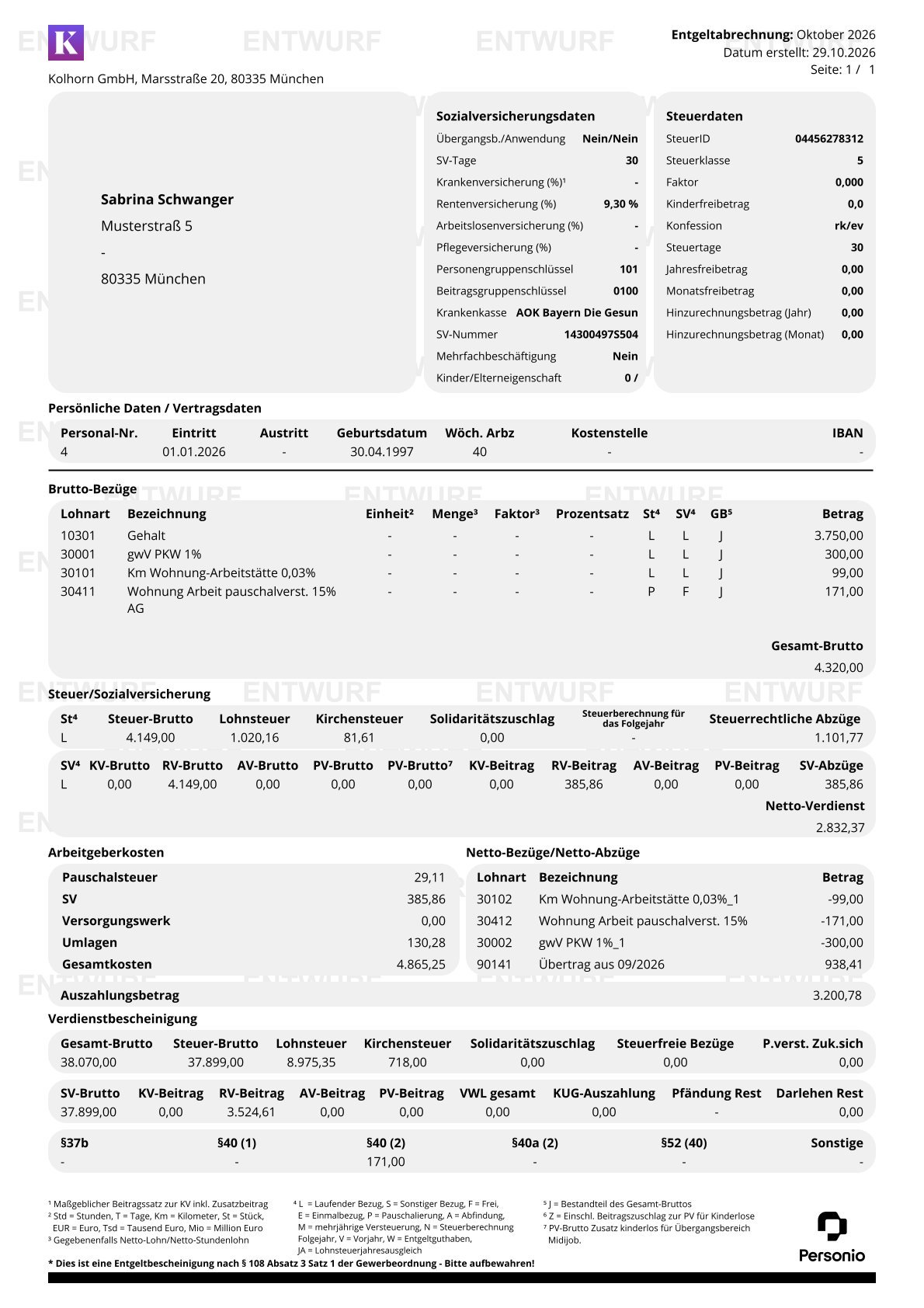
Wage types on the salary certificate
Gross wage types
| Number | Name | Tax | Social insurance |
| 30001 | GWV CARS 1 % | taxable | Subject to social security |
| 30101 | Km of dwelling – place of work 0.03 % | taxable | Subject to social security |
| 30141 | Own contribution for cars | taxable | Subject to social security |
| 30145 | Usage fee for company cars | Taxable | Subject to social security |
| 30411 | Flat, work, flat-rate. 15 % | Lump-sum taxation | SV-free |
Net deductions/deductions
| Number | Name |
| 30102 | Km of home – place of work 0.03% |
| 30002 | gwV PKW 1% |
| 30412 | Flat, work, flat-rate. 15% |
| 30151 | Own contribution car deduction |
FAQ
Is there a non-cash benefit if the employee does not use the vehicle privately?
The decisive factor is the permission for private use and not the actual use. If private use is permitted, apply the non-cash benefit. Only a proven ban on use avoids it.
Can an employee have several company cars at the same time?
In Personio Payroll, only one agreement can be stored per employee. You can track other vehicles manually via one-time or recurring remuneration. If you have any questions, please contact Payroll Support.
What applies if the employee continues to use the company car during sickness benefit, maternity benefit or parental leave?
The non-cash benefit remains taxable. You continue to apply the surcharge for commuting to work for full calendar months. In the case of social security, the benefit can be applied free of contribution according to § 23c (1) SGB IV if, together with the social benefit, it does not exceed the previous net remuneration by more than €50. We recommend clarifying the individual case with the responsible health insurance company.
What does the warning about the lump-sum taxed amount mean?
The amount entered is above the legal maximum. Check the details in the agreement and adjust the amount if necessary. Existing agreements remain billable.